


The “blue economy,” which encompasses industries built around oceans and coasts — from shipping and fisheries to offshore energy and marine biotechnology — is one of the largest, yet least visible, engines of the global economy.
For startups, that means opportunities to modernize how we move goods, produce energy and manage marine resources.
The blue economy has doubled in size in just a quarter of a century, reaching $2.6 trillion in value. To put this in perspective: If the blue economy were a country, it would be the world’s fifth largest. And as the world turns back to the sea to face increasingly critical challenges, from geopolitical instability to rising energy prices and climate resilience, the blue economy is set to become even more central.
Powerful “blue technology” forces of disruption are at play. Digitalization and automation, the energy transition, environmental pressures and advances in marine biotechnology are all reshaping how value is created at sea.
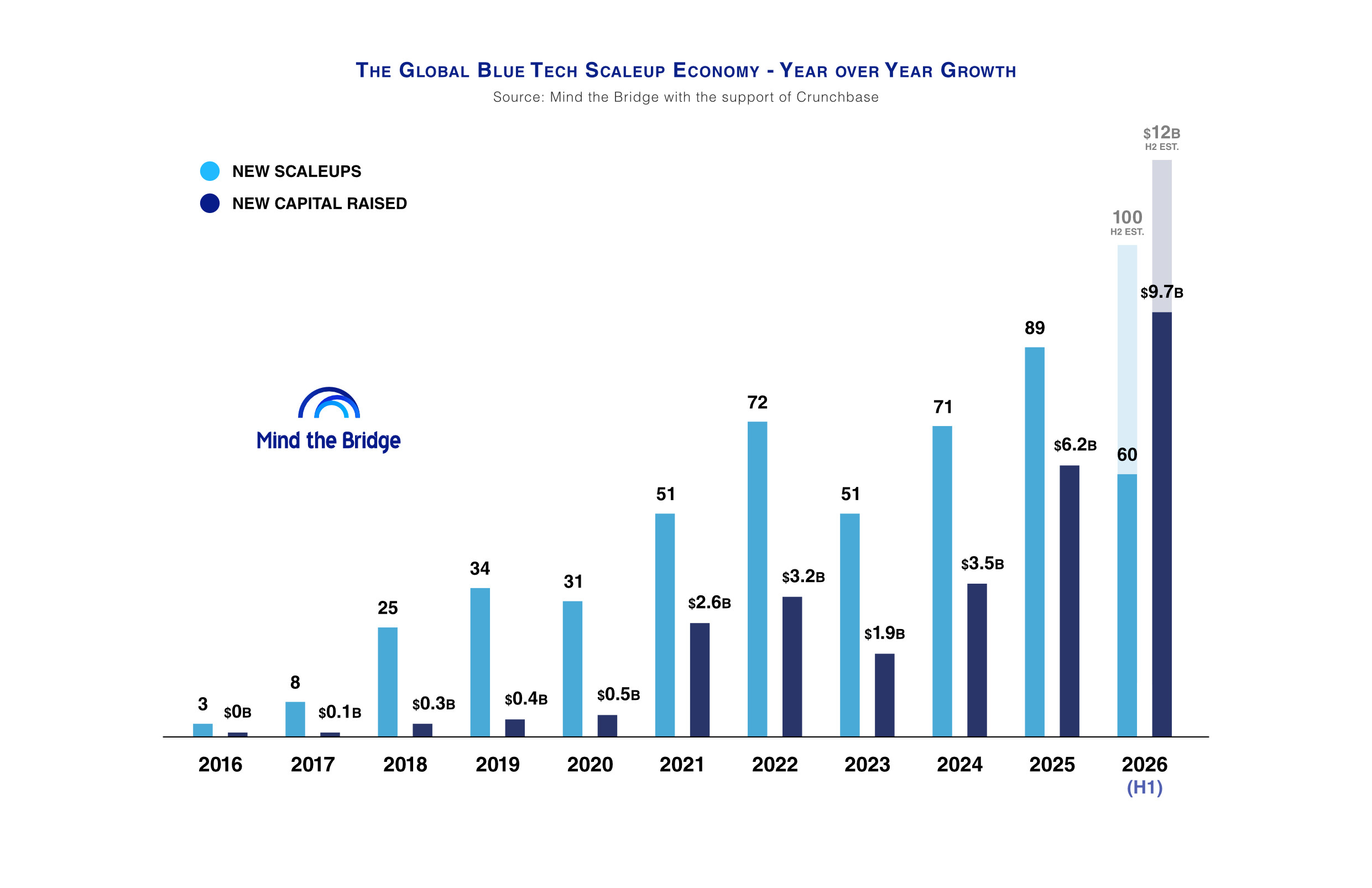
Investment in those technologies is also accelerating, with an emphasis on sustainable development. Blue tech companies tracked in Mind the Bridge’s “Rethinking the Blue Economy” report, produced with support from Crunchbase, raised almost $10 billion through the third quarter of 2026 — already exceeding the $6.2 billion raised in all of 2025. Large rounds for defense companies with maritime applications account for much of that surge.

Blue tech: A sector defying global slowdown
Against the prevailing trend in the global innovation landscape, blue tech has followed a substantially continuous upward trajectory since 2021, producing an average of 70 new scaleups per year — even more rapidly over the past two years. Preliminary figures for 2026 suggest that roughly 100 new blue tech scaleups may emerge by year-end.
The same trend is evident in funding figures. In 2025, blue tech funding has reached $6.2 billion, double than the previous year. As of Q3 2026, blue tech scaleups worldwide had already raised almost $10 billion in new capital. If this trend continues, we expect the sector to attract more than $12 billion by year-end.
The drivers? Exceptional maritime resilience deals involving defense and infrastructure companies such as Anduril Industries ($5 billion raised in 2026) and Helsing ($1.8 billion raised in 2026).
Not all blue tech is the same
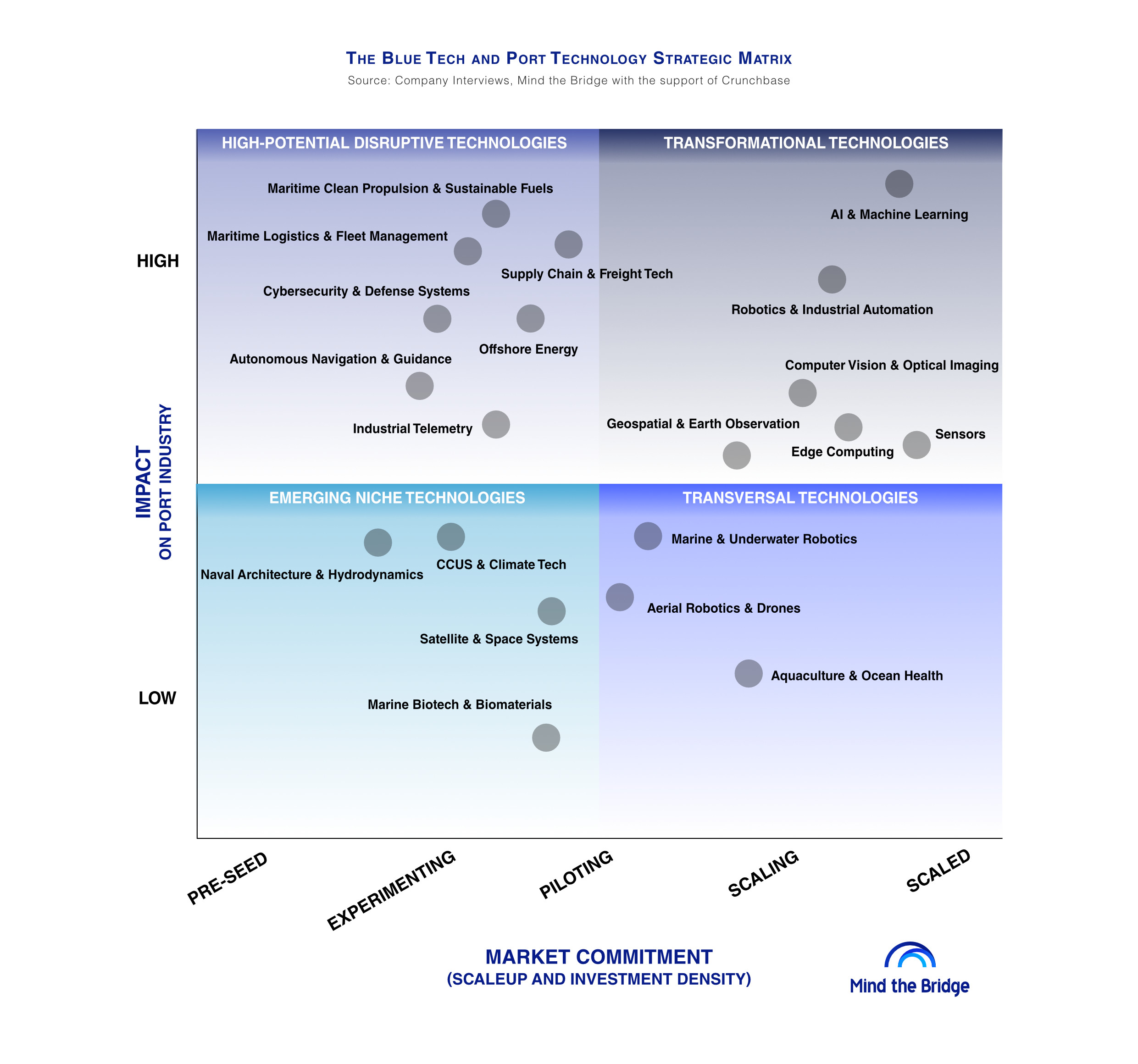
Blue tech is a broad category including a diverse set of technologies, some of which are more mature than others. To shed light on the sector’s composition, we clustered each unique technology developed by blue tech scaleups into 20 groups.
We then assessed each group from two different perspectives: impact on the industry and market commitment (a combination of scaleup and capital invested density).
The result is a matrix highlighting:
- Transformational technologies that have a high impact and are relatively well-established. Among those, AI and machine learning, and robotics and industrial automation occupies a particular sweet spot of high impact, substantial investment and high scaleup density (more than 200 scaleups and $20 billion invested in total).
- High-potential disruptive technologies, with only relatively lower levels of investment and scaleup density (roughly 50 scaleups and $3 billion to $5 billion invested per cluster). Among them, the most promising ones are maritime clean propulsion and sustainable fuels, and supply chain and freight tech.
The other quadrants are populated by transversal technologies with a more indirect impact on the industry and emerging niche technologies.
Ports: the ‘smartest smart cities’
The ultimate question is: Who will ride the wave of change of the Blue Economy?
Short answer: ports.
Ports are where the dynamics reshaping maritime activities converge most visibly, acting as mini “blue economies.” In many ways, ports are the “smartest smart cities” — dense, complex systems where energy, logistics, data, mobility and people meet. They are places where innovation can be tested at scale before spreading to the wider economy.
And like smart cities a decade ago, they now need a playbook.
To provide a comprehensive perspective from the ports’ point of view, in our report we interviewed 10 of the world’s leading port authorities to understand their priorities, challenges and barriers to innovation.
While doing so, we collected several case studies from authorities such as the ports of Barcelona, Bergen, Seattle, Rotterdam and Los Angeles — true blueprints of best practices in tackling the innovation challenges of the blue economy.
The result is a picture that shows the potential of blue tech as the catalyst for a radical evolution of one of the largest sectors of the global economy.
To “ride the wave,” most ports are already activating multiple open innovation tools — some with a structured approach and dedicated units.
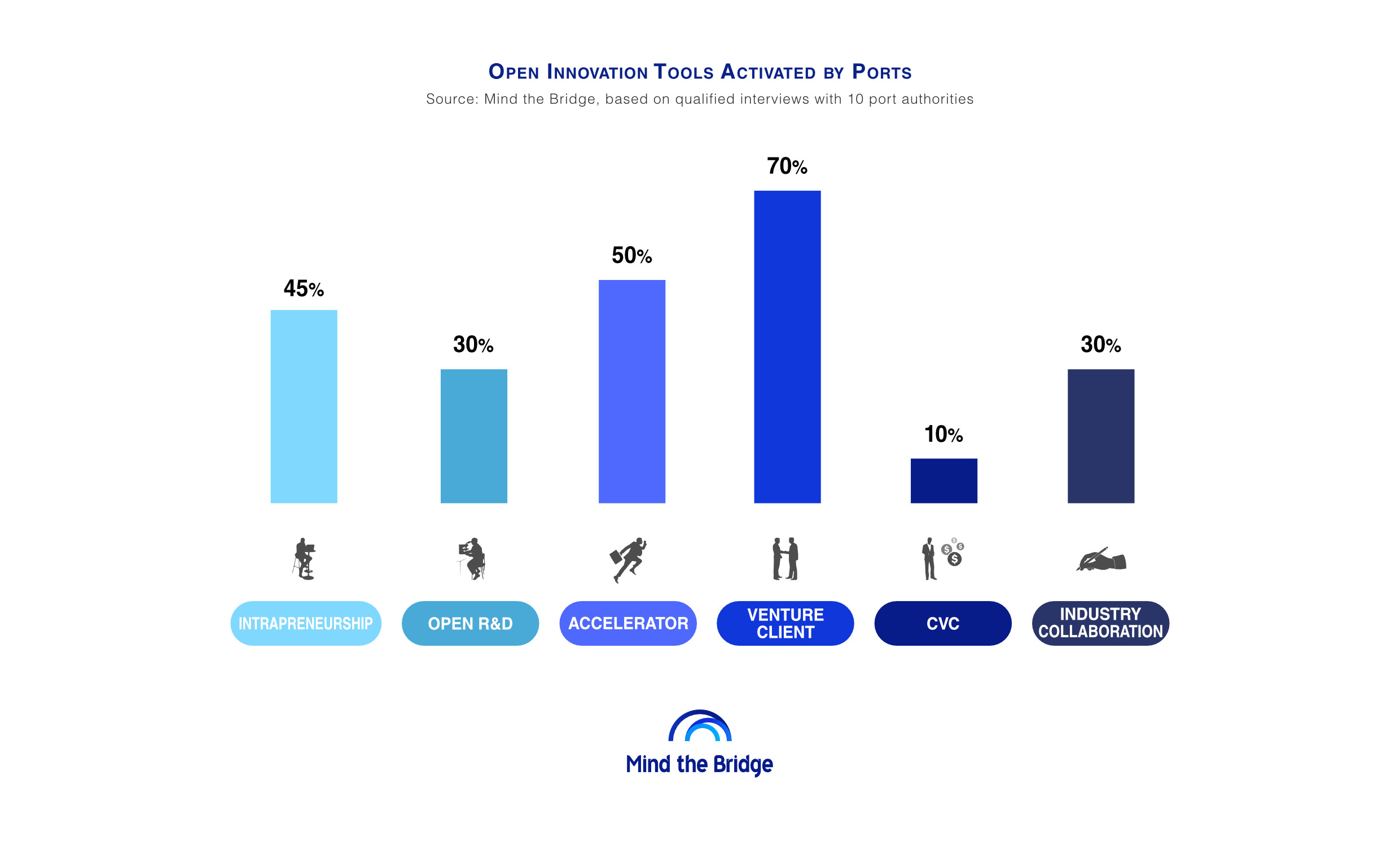
Yet, to really “get there” port authorities, operators, startups, investors and policymakers need a shared agenda and vision, working on the same challenges.
Early but substantial efforts are already underway. A prime example is BlueTechPort by the Port of Barcelona, a collaborative innovation hub connecting entrepreneurs, technology providers, researchers and maritime businesses. The initiative, detailed in a full case study available in the report, is already expanding internationally through the Lighthouse International Acceleration Program, powered by Mind the Bridge.
Notice to (innovation) sailors: the course of blue economy innovation is set. The challenge now is to catch the favorable winds — and ride them.
Get the full story in Mind The Bridge’s report, available for free download here.
Alberto Onetti is chairman of Mind the Bridge and a professor at University of Insubria. He is a serial entrepreneur who has started three startups in his career, the last of which is Funambol, among the five Italian scaleups that have raised the largest amount of capital. He is recognized among the leading international experts in open innovation and has wide experience in setting up and managing open innovation projects — venture clients, venture builders, intrapreneurship, CVCs — with large multinational companies, as well as advising and training on this subject. Onetti has a column on Sifted (Financial Times) and several other tech blogs.

Stay up to date with recent funding rounds, acquisitions, and more with the
Crunchbase Daily.



0 Comments