

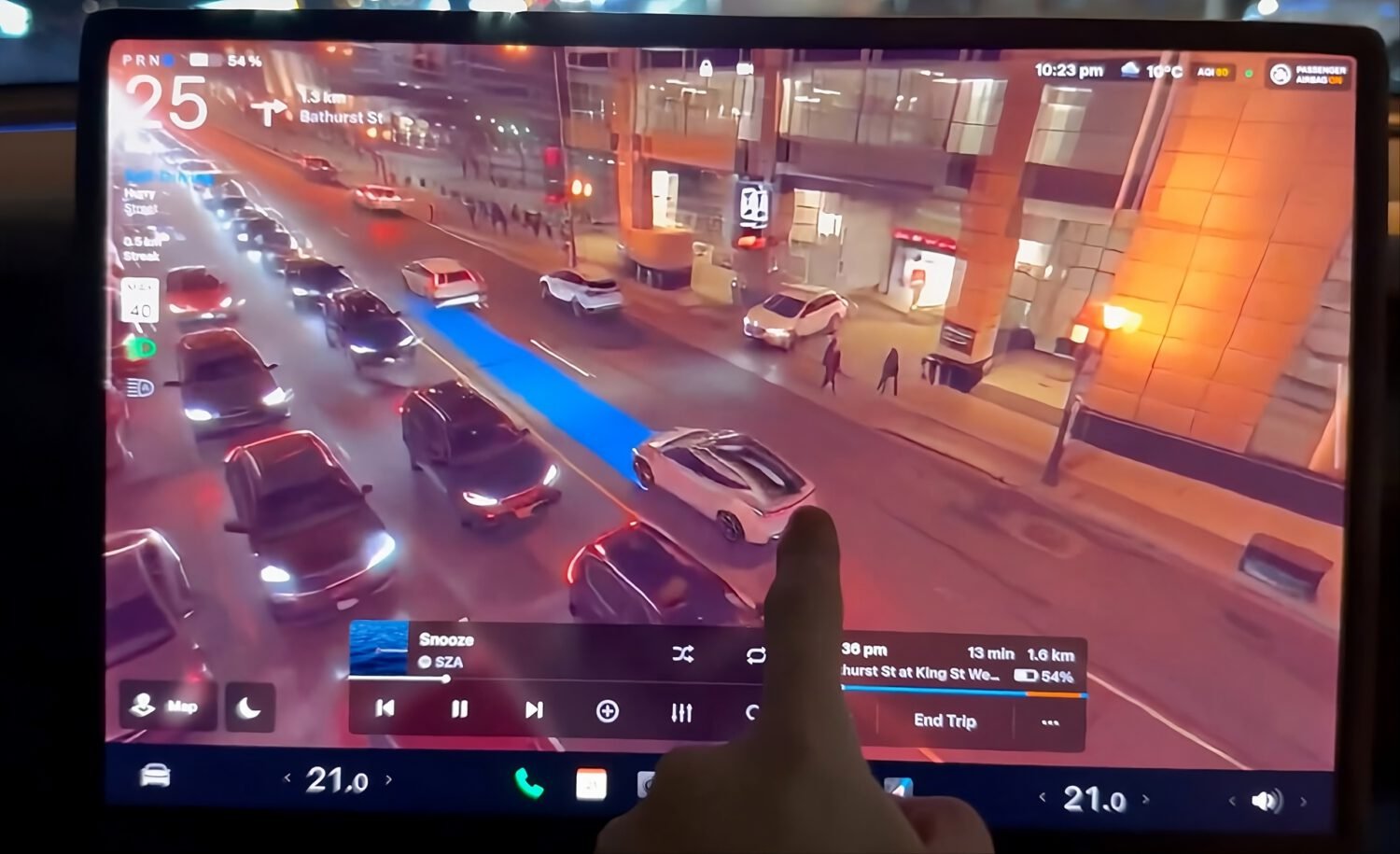
Streetcars, cyclists, and pedestrians crowd a downtown Toronto intersection, and on the Tesla’s touchscreen, the footage appears to show them rendered in a continuous overhead scene that updates in real time. That display is Tesla Reality View, the headline feature of Full Self-Driving (Supervised) v15.0.1, included in software build 2026.38.6.11, which began rolling out November 21, 2026. FSD (Supervised) is Tesla’s driver-assistance product, meaning the driver must remain attentive and in control at all times. For context on how driverless Tesla systems have fared in real-world scenarios, recent robotaxi incidents illustrate the gap between supervised and fully autonomous operation.
What Reality View Actually Does
Tesla’s release notes describe a generative overhead visualization that replaces the system’s earlier object graphics.
According to Tesla’s release notes, the feature replaces the previous system’s object polygons with a generative visualization. That visualization streams a virtual overhead camera view of surrounding vehicles, pedestrians, cyclists, lanes, road features, and planned maneuvers. Drivers can select a full-screen Reality View, a map-only display, or a split view that pairs the visualization with navigation, and upcoming turns appear directly within the rendered scene. Tesla states the system uses less total compute than the prior display architecture, though the release notes do not independently validate that claim.
The Toronto Footage
Social media posts from two observers offered an early dense-urban look at the new interface, though neither amounts to a technical assessment.
Toronto owner Chansoo Byeon shared video pairing downtown windshield footage with the overhead Reality View display, providing an early dense-urban demonstration of the new interface. Separately, Nic Cruz Patane posted on X about the apparent accuracy of streetcar colors and shapes in the rendering. Neither post constitutes independent technical validation of perception accuracy, and the footage does not confirm a Canada-wide rollout or verify the precise software build shown.
A Compelling Display Is Not a Verified Perception System
The distinction between what Reality View renders and what the vehicle has demonstrably understood is the central question the footage cannot answer.
A photorealistic or video-game-style scene can appear highly convincing while still reflecting model uncertainty, latency, occlusion, or visual reconstruction errors. The Toronto clip is strongest as evidence of a redesigned human-machine interface and weakest as standalone proof of real-time accuracy or autonomous capability. That distinction matters because a more persuasive display could encourage misplaced driver confidence.
Other Changes in v15
Tesla’s release notes list a range of perception and behavior improvements, all of which remain the company’s own stated claims.
Tesla’s release notes list expanded perception coverage, including potholes, deep standing water, road debris, small animals, tire chains, and road signs, alongside improved handling around school zones and speed cameras. A new Bike Rack Mode allows FSD operation when a hitch accessory is attached. Automated reversing functions like Autopark and Summon are disabled in that configuration. These are Tesla’s stated improvements from release notes, not findings from independent testing.
The 25x Claim
Tesla’s intervention-rate figure lacks a disclosed baseline or independent validation.
Tesla’s release notes claim a 25x improvement in the critical intervention rate. No disclosed baseline, methodology, or independent safety study accompanies the figure, so readers have no way to evaluate it independently.
Who Gets It, and What It Still Requires
The rollout is limited for now, and the supervised-driving requirement applies regardless of how polished the display appears.
The reported initial rollout targets selected early-access vehicles running Hardware 4, also called AI4. Hardware 3 vehicles remained on an earlier FSD version during the initial rollout, and Tesla has not confirmed broad support for them. Elon Musk has indicated a wider release targeting December 2026 alongside Tesla’s Holiday Update, but no confirmed universal date exists. FSD v15 remains a supervised driver-assistance system; the driver is responsible for the road, and a convincing overhead render does not change that. Drivers weighing the broader costs of electric versus other vehicle types will find that supervision requirements are just one of many factors in the ownership equation.


0 Comments