

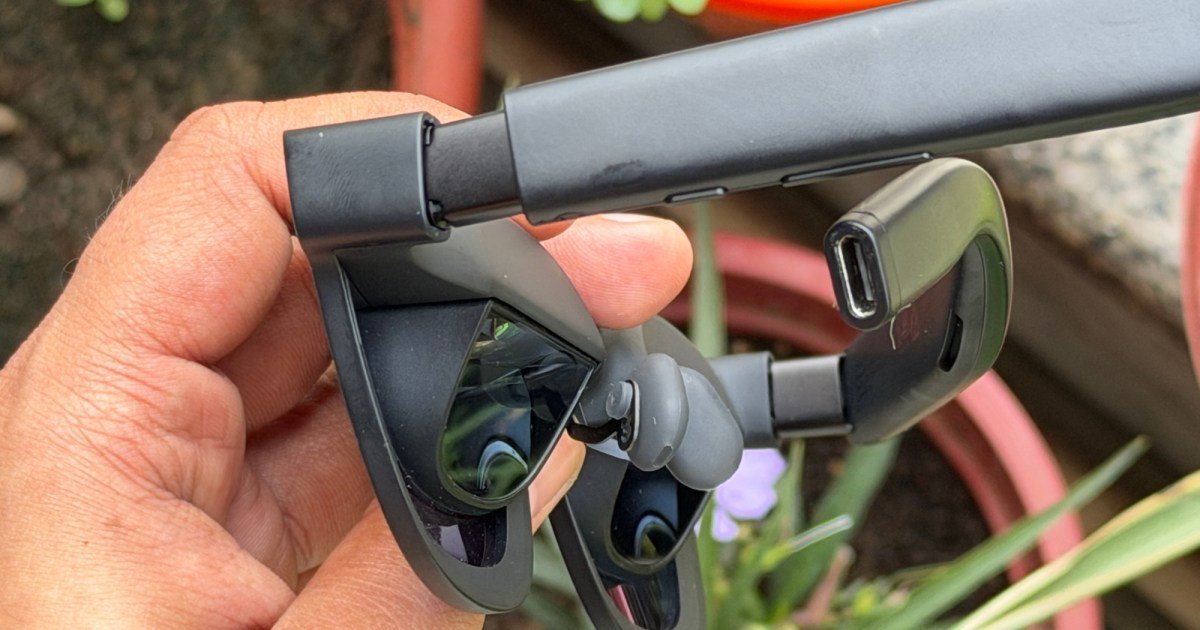
Screens and bright sunlight don’t mix well. Trying to read walking directions or a translated menu in bright sunlight is hard enough on a phone, and it gets even trickier with the transparent lens AR glasses come equipped with. That’s why we’ve got companies like Samsung trying to figure out ways to make displays that don’t suck when you’re outside. Now it looks like there might have been a breakthrough.
Researchers from Pohang University of Science and Technology (POSTECH) and Samsung Research, led by Professor Junsuk Rho, have developed a novel 1.5mm optical system. As reported in Nature earlier this month, they have created a proof of concept for AR glasses that can project white text onto the real world while maintaining good visibility as someone looks around. Samsung Research’s Jeong-Geun Yun and POSTECH’s Hyunjung Kang were lead authors on this paper.
Keeping the image clear when the glasses move
Most augmented reality (AR) glasses use a small display to send light through a thin waveguide. It acts like an optical hallway, directing the image to your eye. However, when you increase the size of the “eye-box”—the area where the image remains clear—more light tends to leak out. This in turn makes the picture dimmer.
To address this, the POSTECH and Samsung team designed a nanoscale light path that keeps light from escaping where it shouldn’t. According to the Nature study, the setup delivers an 8-by-8-millimeter viewing window with a 30-degree field of view, giving your eyes more room to shift without washing out the picture.

Getting the colors right
The researchers also had to be clever about the way they set up the display. This is because red, green, and blue light don’t travel through the same microstructures with equal efficiency, so whites can look tinted, like a cheap projector that’s drifted off-balance. So they stacked a blue- and green-transmitting layer over a red- and green-transmitting layer to balance color without making the lens much thicker.
This is another recent advancement toward creating thinner, more practical augmented reality (AR) glasses. A different team has identified a material that could reduce the size of one of the optical components. This development is distinct from Samsung’s first Intelligent Eyewear, which lacks a display and is primarily designed for shoppers.
Of course, it’s worth pointing out that this is just a lab prototype, not an actual product yet. POSTECH has not provided a timeline for when Samsung might release glasses incorporating this design. The team is still working through challenges, such as ensuring the average brightness meets industry standards and addressing issues like rainbow-like artifacts and uneven color.
They’re also focusing on perfecting the two-waveguide stack. “This study shows that by precisely controlling the path of light inside a lens, even a thin lens can produce bright, sharp images outdoors,” Rho said, adding that mass production and AI-based personalized image processing are next.


0 Comments