

A reader asks:
My friend’s 18 year old son wants to get involved in investing. I bought him the JL Collins book The Simple Path to Wealth. I’d like to educate him with one of your updates as well. Out of all your daily updates any one stand out that broaches the idea of keeping it simple, ETFs work and the long term benefit of stock returns?
Reading has been instrumental in my learning journey as an investor. There weren’t nearly as many resources available when I first started as there are today.
No podcasts, newsletters or blogs. So I read every personal finance and investment book I could get my hands on.
I’ve spoken to two college finance classes in the past couple of weeks. In both of those classrooms, students asked me for some book recommendations as well so this topic has been top of mind.
The Simple Path to Wealth is a good starting point.
I’m a big fan of JL Collins. We share a similar mindset on simplicity, long-term investing and saving.
Those are the big things that matter for young people just starting out. The information that was most helpful to me pertained to:
- Personal finance
- Saving and compounding
- Long-term investing
- Understanding the markets
- Market history
- Behavioral psychology
With those concepts in mind, I’d like to share some of the books that had the biggest impact on my thinking over the years.
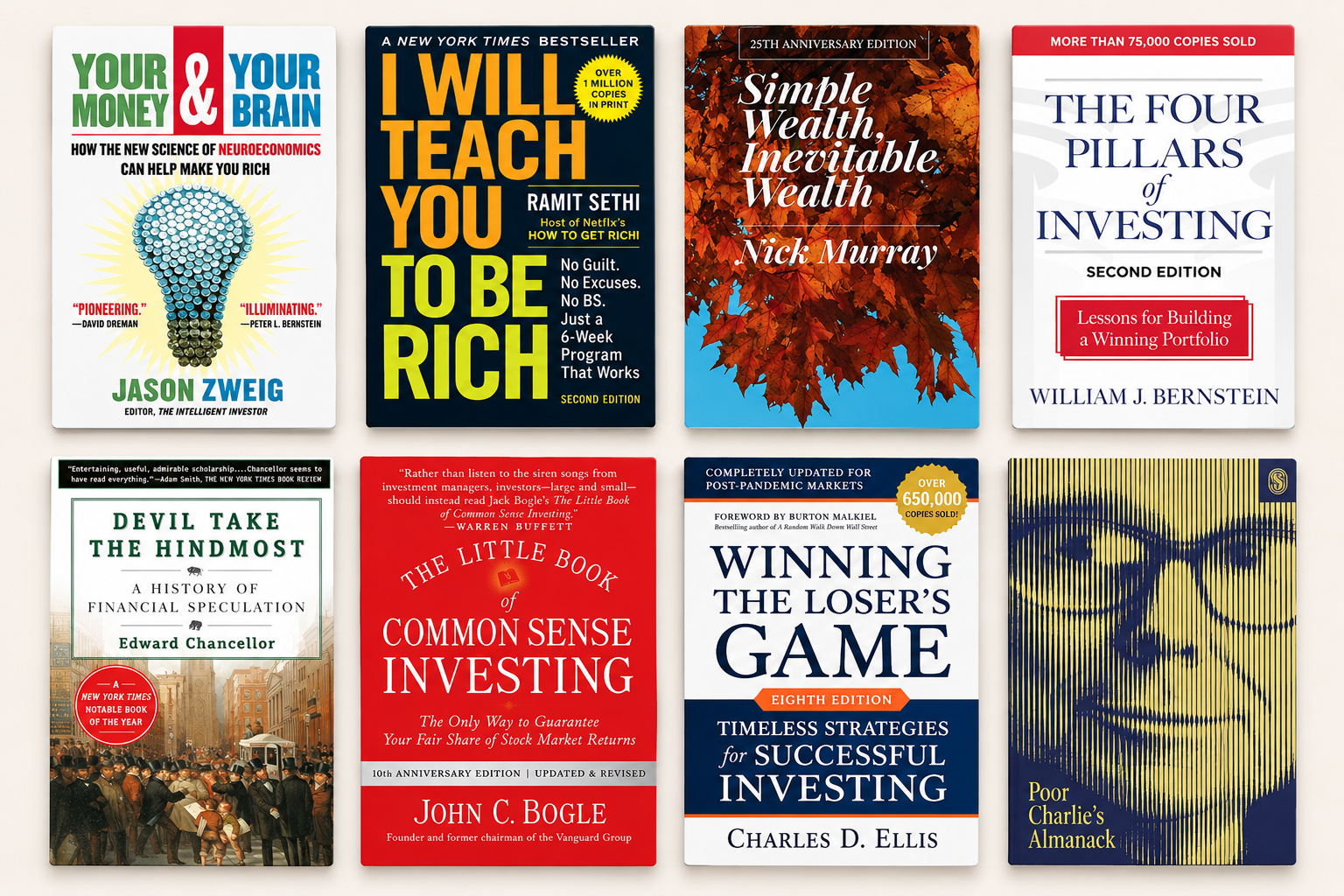
Here’s the list:
Now here’s a little background on each of these books:
Your Money and Your Brain by Jason Zweig
I’ve recommended this one more than anything other book. The ideas about how your body and brain react to making money, losing money and achieving your financial goals are singed into my brain.
I love this stuff:
Once people conclude that an investment’s returns are “predictable,” their brains respond with alarm if that apparent pattern is broken; financial losses are processed in the same areas of the brain that respond to mortal danger; anticipating a gain, and actually receiving it, are expressed in entirely different ways in the brain, helping to explain why “money does not buy happiness”; expecting both good and bad events is often more intense than experiencing them.
As far as I’m concerned, this is the best book ever written about investor psychology.
The Little Book of Common Sense Investing by Jack Bogle
I’ve read all of Jack Bogle’s books. His thoughts on staying the course, keeping costs low and getting out of your own way helped shape my philosophy. This book is a wonderful encapsulation of these ideas.
Bogle sold me on index funds immediately.
I also love his thoughts on investing:
The expectations market is about speculation. The real market is about investing. The stock market, then, is a giant distraction to the business of investing.
It’s an easy read too.
I Will Teach You To Be Rich by Ramit Sethi
Ramit’s blog — also called I Will Teach You to be Rich — was the very first personal finance site I ever read on a regular basis.
I loved it right away because it was a fellow young person talking about money topics that mattered, not some gray-haired old person lecturing me about compound interest.
This book is not only interesting, but it’s useful too because there are tactics galore.
Simple Wealth, Inevitable Wealth by Nick Murray
Murray’s book sits on the bookshelf of many a financial advisor. It’s one of my all-time favorite descriptions of the benefits of long-term thinking and the behavior required to get there.
Murray is direct and to the point in the best way possible:
There is no such thing as no risk. There’s only this choice of what to risk, and when to risk it.
I’ve re-read this one multiple times.
The Four Pillars of Investing by William Bernstein
I’m a fan of all of Bernstein’s books but this one is the OG. It has just the right mix of market history, portfolio management techniques, investor behavior and wonderful lines like this:
Finance is not a hard science like physics or engineering; rather, it’s a social science. The difference is this: a bridge, electrical circuit, or aircraft will always respond in exactly the same way to a given set of circumstances, while the financial markets do not.
The Investor’s Manifesto is a nice follow-up read as well.
Devil Take the Hindmost by Edward Chancellor
When you’re young and lack experience in market cycles one of the best ways to play catch up is by studying market history.
This is perhaps my favorite market history book because it covers all of the biggest booms and busts: the Tulip Mania, the Mississippi/South Sea bubbles, the Railway Mania, Florida land boom, Roaring 20s, Black Monday, Japan asset bubble, dot-com bubble and much more.
It’s like a greatest hits for extreme market cycles.
I love the way Chancellor describes the Roaring 20s, which sounds eerily familiar to the current decade:
Perhaps, as some claimed, the Roaring Twenties were morally degenerate years deserving of a biblical visitation: but they were also a period when people exhibited a capacity for dreaming, a faith in the future, an entrepreneurial appetite for risk, and a belief in individual freedom. These profoundly American traits took a severe knocking in October 1929 and appeared to be extinguished during the Great Depression. They would return.
Every investor needs to study market history and this book is a crash course.
Winning the Loser’s Game by Charlie Ellis
The tennis analogy from this book about professional versus amateur players is what sticks with you but I also love this passage about simple versus complicated:
Please keep in mind the observation of two of my best friends, who are at the peak of their distinguished careers in medicine and medical research. They agree that the two most important discoveries in medical history are penicillin and washing hands (which stopped the spread of infection from one mother to another by the midwives who delivered most babies before 1900). What’s more, my friends counsel, there’s no better advice on how to live longer than to quit smoking and buckle up when driving. The lesson: advice doesn’t have to be complicated to be good.
Ellis also describes the three ways to win at the game of investing which I’ve been using for years.
Poor Charlie’s Almanack by Charlie Munger
My dad gifted me this book for Christmas early in my career after someone recommended it to him.
The book is a collection of Munger’s speeches, essays and observations about his so-called mental models. Munger talks about math, markets, physics, biology, history, engineering, economics, behaviors and more.
I learned more from this book about incentives, psychological tendencies and human misjudgment than anything I learned in school.
This book feels like a master’s class in understanding human behavior.
I answered this question on an all-new episode of Ask the Compound:
We also answered questions about Nvidia, financial advice for NFL players, leveraged ETFs, indexing vs. systematic trading strategies and more.
Further Reading:
9 Underrated Investment Books

0 Comments