

A year ago, Zcash [ZEC] began a remarkable rally. After gently ticking upward from $34 to $60 in August and September 2025, the privacy token led an explosive sector-wide bullish charge.
On the 1st of October 2025, entrepreneur and angel investor Naval Ravikant posted on X that,
Bitcoin is insurance against fiat. Zcash is insurance against Bitcoin.
It helped kick off a wave of bullish enthusiasm for ZEC as well as the privacy sector. Zcash surged by 1,135% in five weeks, Dash [DASH] rallied 605%, and Monero [XMR] was up by 181% from early October, though its move took longer, until January 2026.
Neither of the latter two tokens has managed to regain the highs they made back then.
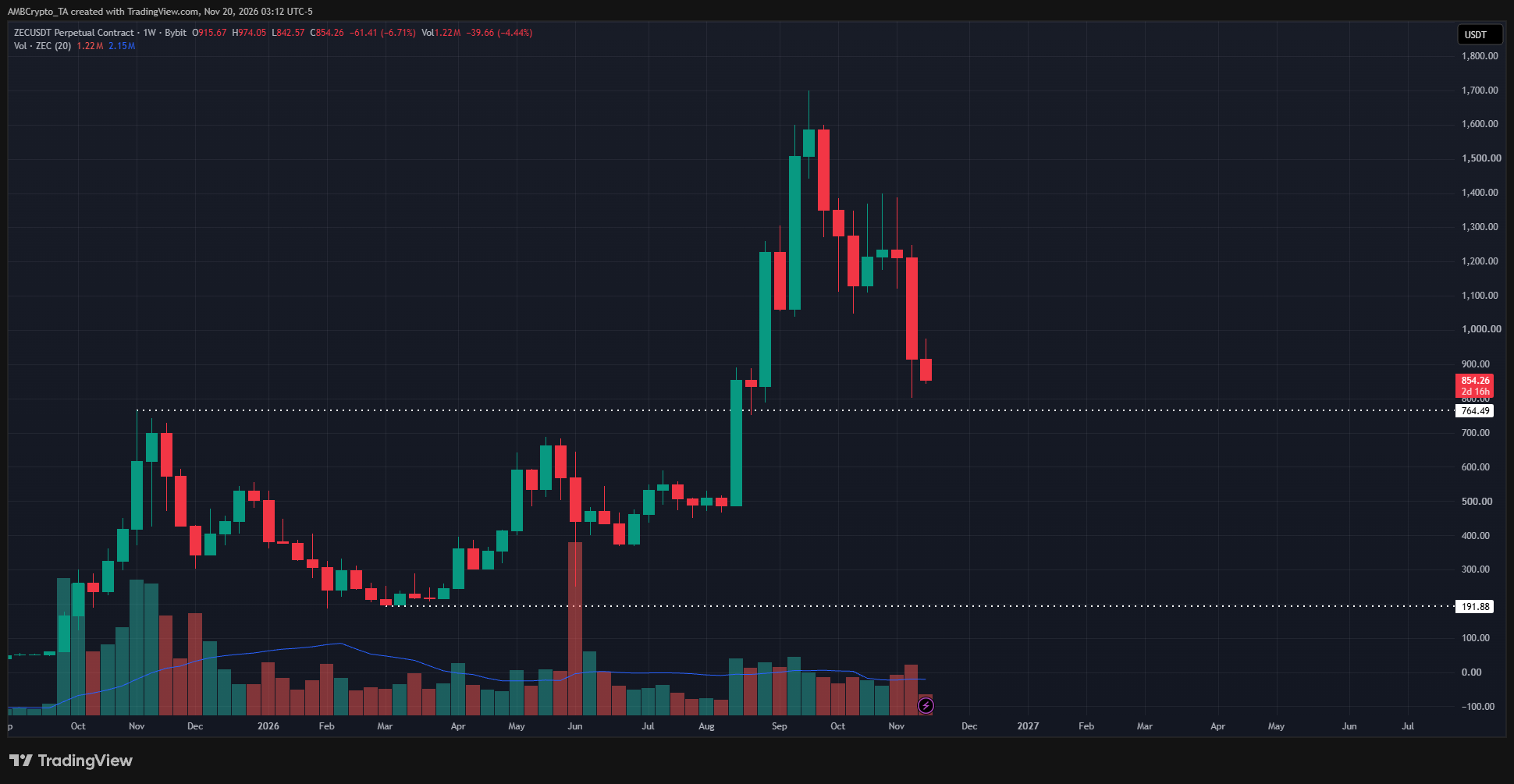
Meanwhile, ZEC reached $1,700. The altcoin’s correction in recent months back below $1,000 has sparked bearish short-term sentiment, even though it was still trading above the previous year’s peak.
Apart from expansion on the price front, the privacy sector leaders have made substantial progress in 2026. The need for privacy is nuanced. Users want confidential smart contracts, not just standalone privacy.
Monero and Zcash continue development despite bear market conditions
Currently, Monero uses RingCT to hide transactions. RingCT, along with CLSAG ring signatures, enforces a fixed ring size of 16- 15 decoys plus one real input. This makes it harder to trace the address for each transaction, without requiring other users to break deterministic trails, which privacy methods such as CoinJoin for Bitcoin require.
Sophisticated on-chain analysis can still narrow down to the 16 possibilities over multiple “hops”, or intermediate payments or asset transfers along a transaction trail.
Monero’s Full Chain Membership Proofs++ (FCMP++) eliminates the need for decoys. It replaces rings by providing zero-knowledge membership proofs across the entire blockchain output set. In other words, it mathematically proves that the spent XMR belongs to the Monero blockchain, making every previous output created part of the decoy set.
A mainnet activation date has not been confirmed for the FCMP++ and Carrot, the addressing protocol and wallet key hierarchy upgrade designed for the FCMP++ network upgrade. AMBCrypto reported that zkSecurity’s audit of FCMP++ was “complete, zero-knowledge, and sound”.
While Monero enforces privacy on every transaction, Zcash gives users the option of privacy. It has transparent transactions, but also allows the use of zero-knowledge proofs (zk-SNARKs) when shielded addresses are used.
Using zero-knowledge cryptography, private ZEC balances and transactions are tracked in shielded pools. Zcash has five of these shielded pools, as well as its transparent pool. Once funds are inside, the older pools can not be shut down, but can be made spend-only.
The Ironwood (NU6.3) upgrade was launched on the 28th of July, 2026, addressing the Orchard “infinity” bug found in May. It also introduced a new shielded pool and restricted the Orchard pool. Funds exiting Orchard must now pass through Zcash’s turnstile, for supply integrity verification, to enter Ironwood.
The NU7 upgrade implemented in November aims to reduce block processing times by 67%, from 75 seconds to 25 seconds. It also reduced the wallet scanning workload required to perform private payments.
The upgrades are an encouraging sight for long-term users and investors. At the same time, the use case for privacy is also expanding.
Privacy is not just about anonymity
When transactions are shielded in some form, anti-money laundering (AML) tracing is hindered or prevented. This brings strict regulatory restrictions on shielded transactions, as they require visibility in fund flows to prevent illicit financing.
As open blockchains, such as Ethereum [ETH] and Solana [SOL], enter the financial mainstream, institutional adoption requires them to address privacy. Their open nature means accessibility risks become a competitive liability and can have legal, financial, or operational repercussions.
Blockchain data and analytics platform Chainalysis wrote that institutional adoption is accelerating privacy network growth. Institutions must choose the right technology for their needs, whether it be shielded pools (like Zcash) or encrypted extensions (like Solana’s confidential transfers).
Canton [CC] is purpose-built for institutions. The network’s sub-transaction privacy hides all transaction details, even the transaction’s existence, from all but the parties involved. This segmented information sharing embeds privacy into the chain.
There is a case to be made for both financial privacy and financial oversight. The former argues for a fundamental right in a world of persistent data collection and financial surveillance.
The latter argues that oversight is a necessity to prevent serious crimes and to detect and disrupt illicit activity.
Elliptic, another blockchain analytics company that provides crypto compliance software, noted that crypto projects can embed compliance-supporting features without wholly abandoning privacy.
Selective disclosure, such as in Zcash, Midnight, or using Identity Frameworks in Ethereum, can achieve this by sharing transaction details without revealing the entire financial history.
Zero-knowledge compliance is another approach that can prove that a transaction meets certain criteria, without exposing other relevant details.
Finding this middle ground between oversight and privacy is becoming increasingly important to create a secure, yet private, digital future.
Final Summary
- A year from exploding in popularity, ZCash and Monero have strong ongoing development as they strengthen privacy and pursue scaling.
- The privacy sector needs more than just retail anonymity. Institutional and commercial usage requires privacy, and compliance-supporting features are a necessity.



0 Comments